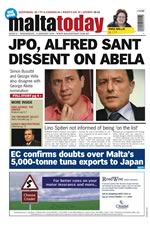
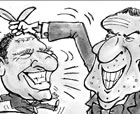
He whipped up a storm upon his return from Labour’s wilderness, and now he gets to be President of the Republic. How does it feel to be George Abela, JAMES DEBONO asks?
George Abela’s status as “the most favoured Labourite” among Nationalists has earned him the presidency instead of the Labour leadership he coveted.
It plays out with great irony. Unlike the former Nationalist ministers promoted to the presidency by their own government, Abela finds himself kicked upstairs by Joseph Muscat – his rival in the Labour Party’s leadership contest – before becoming a thorn in his side.
To a certain degree Abela’s choice suited both Gonzi and Muscat. While Muscat appeared magnanimous, by apparently nominating a former rival (he said Abela ‘was on his list’ although Gonzi says he proposed Abela on 29 December without ever receiving a list of names) as well as exorcising his reputation as Alfred Sant’s poodle and acolyte when he also nominated Lino Spiteri, Gonzi finally managed to show his boldness and ability to bridge partisan divide, serving him well in years to come.
The transformation
But there is a curious twist to the way Spiteri, a former Labour minister of the 1980s, and Abela, once Labour’s deputy leader for party affairs, found themselves in the Nationalist party’s good books. Their fall-out with Alfred Sant during his tumultuous two years in government and their subsequent support of Malta’s EU membership bid gave them a renewed sheen in the eyes of the Nationalists.
And remaining as they do in Sant’s bad books, Muscat has only asserted his complete independence from Sant by nominating them for the presidency.
But Abela was not an outcast without support from inside Labour. Abela would not have been nominated for the presidency had he not first managed to prove how he was still liked and supported by many rank and file Labourites. When he forced a run-off against the anointed Muscat, and won the support of 291 Labour delegates, he proved that his fall from grace from Labour and the GWU did little to diminish his appeal among Labour delegates. He was still a force to be reckoned with.
Abela’s popularity owes its origins to his strong roots in the General Workers Union and his successful stint as Malta Football Association president between 1982 and 1992. But it was his pivotal role in the MLP’s leadership triumvirate that won the 1996 election on a platform to abolish VAT and freeze the EU membership application.
And then, less than only two years later, he abandoned the MLP’s sinking ship in 1998, after disagreeing with Sant’s decision to call an early election following Dom Mintoff’s one-man revolt, which denied him his one-seat majority in parliament.
Even after falling out with Sant, Abela retained his post as legal advisor of the General Workers Union, and in 1999 joined the militant leadership in blocking a police bus carrying arrested union activists to prevent it from reaching the police headquarters: an action for which they were later pardoned.
A year later Abela fell out with union secretary-general Tony Zarb and was heavily involved, on a personal basis, in MEUSAC, the steering committee that discussed government’s negotiating position with the EU. Eddie Fenech Adami publicly thanked him for his work in two mass meetings.
This transformation turned George Abela into a thorn in the side for the leaders of the two branches of the Labour movement. His name wistfully cropped up in some messianic formula for Labour’s return to power.
And yet, despite this latent popularity, he twice failed to stand against Alfred Sant while many clamoured for his return in 1998 and 2003.
The return
His next foray into the public arena took place in April 2004, when he was appointed as a facilitator by the GWU and three other unions engaged in discussions on the re-structuring of Air Malta. This led to a breakthrough in the discussions with the government.
But then, in 2006 port workers defied the GWU leadership by appointing Abela as their legal representative. After falling out with Tony Zarb, a new union called the Malta Dockers’ Union was set up and Abela was appointed as its legal advisor – a move which deprived the GWU of its power to paralyse the country by blocking the ports.
The 2008 general election loss brought with it Alfred Sant’s resignation. Here Abela returned with his promise of a “leadership that guarantees success”, boosted in part even by being cast as an outsider whose candidature was publicly rebuked by the party’s secretary-general Jason Micallef.
Considering the odds, Abela’s comeback was all the more surprising.
Initially supported only by his friends in the diaspora of exiles from the Malta Labour Party and the General Workers Union, George Abela was fast making inroads in the party. Initially, Abela’s bedrock of support seemed to come from fellow Labourites who had fell out with Sant, namely the economist Alfred Mifsud, the former minister and 1992 leadership rival Lino Spiteri, and former party secretary-general Dominic Fenech; and also parallel exiles from the GWU who fell out with Tony Zarb, following his trouncing of Manwel Micallef in the union’s leadership race in 2006.
Following his honourable defeat, Muscat took up the challenge to reinforce his party’s battered image of being prone to exclusionary and territorial tactics. Abela was immediately chosen by Muscat to represent the party on the reconstituted MEUSAC. But Abela’s refusal to contest the European elections was a slap in the face for Muscat, and maybe a sign that Abela was still bitter after an acrimonious contest.
But by proposing him as President, Muscat has surely shown his goodwill towards Abela; a gesture which could also gain him the respect of those among Abela’s supporters who have not warmed up to Muscat.
Gonzi’s sideways step
Lawrence Gonzi’s endorsement of Abela as President effectively relieves Muscat of a potential rallying cry for party dissidents. Opposition politics can only be beefed up when there is a cause for opposing. Abela’s appointment divests Labour of an arsenal of criticism.
On the other hand Abela’s choice relieved Gonzi of making an uncomfortable choice within his own ranks. Choosing Joe Borg, the European Commissioner, would have opened the floodgates for intense competition for the post of Malta’s European Commissioner, coveted by the party’s eminence grise Richard Cachia Caruana. Opting for Speaker of the House and former minister Louis Galea would have brought on lashings of criticism from the Opposition, and even the unlikely choice of Giovanna Debono would have only been a reward for the party’s old guard which he pushed aside during the general elections.
Ironically, back in April George Abela claimed a member of the party administration had proposed him not to contest the leadership election, promising a nomination for the presidency in return. As it turned out, had he not contested the election, his candidature would have lacked legitimacy in the Labour camp.
Gonzi knows that there is more yet to come: Abela will only go down in history as Malta’s first unanimously elected President since Sir Anthony Mamo, only if Alfred Sant – who is still an MP – votes for his former nemesis.
There’s a curiously unkind twist to this entire story: without falling out with Sant, Abela would have never gained the respect and trust he enjoys with the Nationalist government; nor would he have been proposed by his own party had Muscat not felt the need to break ranks so symbolically with his predecessor.
That Sant features so artlessly in yet another game of political chess, just makes you think.
Any comments?
If you wish your comments to be published in our Letters pages please click button below. Please write a contact number and a postal address where you may be contacted.
Download front page in pdf file format
All the interviews from Reporter on MaltaToday's YouTube channel.
Artists, art critics and friends unanimously gather to remember the impact and value of Ebba von Fersen Balzan’s work and her strong connection with the Maltese islands