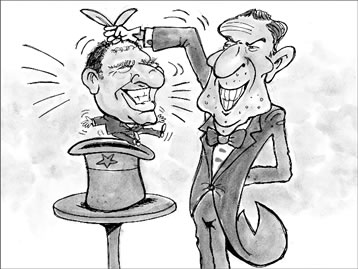
It is with apparent renewed political vigour that the nation seems to have rallied behind the choice of George Abela, the former Labour deputy leader who came close to becoming Leader of the Opposition last year.
It is a choice that has also taken many by surprise. For the first time since the appointment of Sir Anthony Mamo, then Chief Justice, to take over the reins of the Republic back in 1974, a man that does not hail directly from the ruling party has been appointed Head of State. It is a move that has given political maturity a new meaning in the Maltese context: for years the nation explicitly accepted that Maltese politics was a zero-sum game in which the winner takes all; a political culture of nepotism where even the Head of State, a role that should symbolise national unity, was expected to be occupied by someone enjoying the undivided trust of the ruling party.
So here is George Abela, the man who has bridged the gaping division between two parties, and two electorates. There is no doubt that the nation is looking upon Lawrence Gonzi as having taken a brave decision, a “mature” move to build bridges and reach out to a greater part of the electorate by embracing a man of Labour as the next Head of State.
And the Prime Minister certainly underlined the boldness of his choice when he pointed out how the time had come for the Maltese people to move beyond the narrow confines of its partisan modus vivendi.
But surely, the Prime Minister must have been mindful of how politically beneficial his magnanimousness will turn out to be.
George Abela not only enjoys the acceptability of the Maltese nation and the political parties. He retains untold respect among a large segment of the Nationalist electorate, which appears unfazed by his role in the Labour triumvirate that so rudely swept the carpet from beneath the Nationalist government’s feet in 1996.
In part, his acceptability owes to his palatable persona, surely an important ingredient for a Head of State if he wants to enjoy national approval. Undoubtedly, his friendship with Gonzi, honed during their years studying law at university, came into play as Gonzi himself noted when he paid tribute to the values Abela cherishes.
But it was Abela’s political history that ultimately crystallised his ‘acceptability’ for Gonzi to move ahead with his nomination. Because apart from the decade spent as president of the Malta Football Association, Abela seemed to have earned an enormous degree of credibility for having resigned from deputy leader of Labour in 1998, in protest at Alfred Sant’s decision to go for early elections.
His momentous move, coupled with his support of EU membership, and his subsequent severing of ties with the General Workers Union, left Abela unblemished by his association with Alfred Sant, an association that would have undoubtedly hung heavily on any other nominee.
For it is in these years, that Abela seems to have shunned political risk – refusing to go with Labour into precariously early elections, twice refusing to launch a challenge against Sant’s hold on Labour, and only embarking on his final political campaign after Sant’s resignation. Almost akin to an exiled prince returning to rebuild a country ravished by its former ruler, Abela’s campaign for the Labour leadership won him accolades from across the political spectrum. Here was a Labourite who struck some unheard chord with the Nationalist electorate.
Unlike previous presidents, bar Sir Anthony Mamo, Abela was never a member of the government executive or an MP. His uncontroversial career, the respect he enjoyed in the legal circle and with Nationalist MPs and pundits, and the fabled enmity with Sant, did much to carve his idoneous credentials for Head of State.
But that alone does not justify why Lawrence Gonzi nominated him for the presidency. With his masterstroke, Gonzi has surely neutralised a great deal of criticism that will emanate from Labour, especially when it comes to frequent accusations of the government’s network of favoured appointees. Consider for example the degree of outrage at the appointment of his predecessor Eddie Fenech Adami straight to the role of President.
But with a man of Labour representing the nation, Gonzi appears to vindicate the not insignificant opposition of his party to the establishment of the Republic back in 1974. In the eyes of the nation, Gonzi appears to have embraced the ‘non-partisan’ and unifying symbolism of the figurehead that the Head of State should be, and will serve him as a feather in his cap for years to come.
While Joseph Muscat attempts to secure as much credit for this historic decision as possible, the Opposition leader may be thinking that at least, he certainly cannot be accused of being on the leash of his own predecessor.
In this political game of heresy, Abela’s appointment leaves the critics and the Cassandras dumbfounded. There is just not enough in Abela to stir up emotion.
Any comments?
If you wish your comments to be published in our Letters pages please click button below. Please write a contact number and a postal address where you may be contacted.
Download front page in pdf file format
All the interviews from Reporter on MaltaToday's YouTube channel.
Artists, art critics and friends unanimously gather to remember the impact and value of Ebba von Fersen Balzan’s work and her strong connection with the Maltese islands