|
Some describe the Broadcasting Authority as a ‘watchdog,’ others as a ‘set of teeth,’ and others still a ‘dinosaur,’ a ‘monster’ and a ‘fund-raiser.’ Its chairman, Joseph Said Pullicino has his say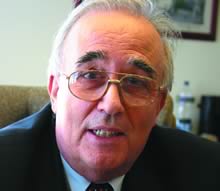
From the virtually untouchable chair of Chief Justice to the hot seat at the helm of the Broadcasting Authority, Joseph Said Pullicino has spent these last two years in the line of fire of both political parties.
Last year’s referendum and election campaigns divided this country yet again into two poles, with the ensuing divisiveness reflected – and propagated – on the broadcasting media, just in the wake of the tenth anniversary of pluralism.
Right in the middle of the controversy was the Broadcasting Authority, attacked from all fronts for its contentious decisions – considered inadequate for some, draconian for others – taking all the flak for its Constitutional duty. The upcoming European Parliament election campaign now promises even more controversy for the BA.
But with all the poor, mediocre broadcasting quality we’re getting from our television stations, is the Broadcasting Authority doing justice to its name?
Take the two TV stations owned by the large political parties – Net and Super One. While the authority keeps breathing down the necks of PBS journalists to ensure some kind of balance and impartiality, Net and Super One seem to have a free for all when it comes to blatant propaganda, if not lies, in their news bulletins.
When he was appointed chairman, Dr Said Pullicino had predicted, somewhat optimistically, that “little by little we will reach a point where parties themselves will realise it is in their own interest to give their viewers different perspectives about an event or issue.”
Two years since, it seems that things have turned for the worse?
“I wouldn’t say things have turned for the worse,” a still hopeful Dr Said Pullicino replies. “The political circumstances of the moment provoke a charged atmosphere and things tend to get worse in such circumstances. I distinguish between the Parties and Party stations, and there are professionals working in the political Party stations that believe there should be more balance on their own stations to give a fair deal to viewers.”
But that’s not what they’re doing. Only last week, he expressed his own disappointment at the party stations’ transformation into propaganda machines. If balance is important, it cannot be limited to public television.
“There are programmes which strike a balance and others which definitely don’t,” he explains. “The element of propaganda is still very strong and that’s where they’re providing a disservice to the audience.”
Agreed. So what is the BA doing in this regard?
“The way the law is drafted gives leeway to the parties’ interpretation, that one station balances the other,” he says. “That’s the parties’ interpretation of balance. I personally disagree with this interpretation.
“But rather than declaring direct war on politicians, I think it would be better to resort to persuasion, to convince them that it’s in their own interest; rather than imposing our will. At the end of the day both parties look after their own interests first and both of them agree they should have a free hand to do whatever they wish.
“But it would be wrong to say that all programmes are imbalanced. My point is that when it comes to news, political party stations should take a different approach. While they have every right to give news their own slant, they should respect facts for what they are, and comment should be presented as such.”
Clearly, Dr Said Pullicino has not managed to persuade the two parties on this one yet, leaving the BA with a reputation of a toothless institution when it comes to regulating political stations.
“The authority’s teeth are only as sharp as the law allows,” he says. “I believe that it in the last two years it has used its teeth wherever and whenever it had to use them.”
To make things worse, Dr Said Pullicino chairs a Board made up of four members, two appointed by each party, Alternattiva Demokratika excluded. Doesn’t he believe the Board should have a much wider representation from society?
“It’s true, political polarisation has been transported to this Board,” Dr Said Pullicino says. “Undoubtedly, I agree with a wider representation; I actually advocate it. Widening representation on the Board would reflect public opinion more fairly, and besides, it would ensure that decisions taken would not be based only on Party political grounds. One of the main problems I see in broadcasting is that problems are only considered from a political standpoint. Party politics is important, but not to the point that it becomes all-encompassing.”
Once again, such a move would require the consent of both Government and Opposition, and everyone knows that both of them are not very willing to give away an inch of their territory.
“Well listen, I think it is about time that one studies the way the Constitution and Broadcasting Law are written, because in my view they do not respond to today’s needs anymore,” Dr Said Pullicino says. “The Constitution was written when we just had public broadcasting, and it was easy at that time for the BA to produce its own programmes and allocate equal air time. Nowadays it is a regulator, and there is a lot that needs to be done to bring the Constitution and Broadcasting Law – passed 10 years ago – in line with today’s requirements.”
But it doesn’t seem to be in the two parties’ interest to change anything in this regard, I insist.
“I’m not concerned with the parties’ interests, I’m concerned with democracy. The democratic process requires free speech, it requires giving freedom of expression to everyone, and that’s also in the parties’ interest because citizens are not stupid. They want to be free to speak and to be informed, and they are right.”
The right to information happens to be another victim of the current situation of broadcasting, and its aggressors are not just political parties. In fact, the imperative of audience ratings is leading so-called current affairs programmes on our national public service broadcaster to exalt triviality, producing junk television instead. The prime example remains Xarabank. What does the BA say about that?
“Let me put it this way, triviality is a question of content – one can view it wrongly, neutrally, or rightly – one cannot be categorical. Style itself does not necessarily provoke the authority’s intervention, although we do encourage quality and standards.”
But on a station such as TVM, which is supposedly giving a public service, does a programme like Xarabank fulfill its mission to discuss current affairs?
“Personally, within the context of PBS, I don’t think it’s the best medium to discuss a subject seriously,” Dr Said Pullicino replies.
“However, I understand its role of putting forward serious subjects in a popular manner. I don’t see style as a point on which we should be intervening, although I assert the PBS Board’s right to have a say on the programmes it commissions.
“I strongly believe in establishing a strong editorial Board for PBS which controls content and balance. That Board should be guided by a binding and public code of behaviour that provides for a procedure of redress and remedy in case of breach.”
Actually there is a PBS editorial Board in place, but it seems Dr Said Pullicino is not very satisfied with it.
“Let me put it this way; there is an editorial Board and some progress has been made, but it hasn’t reached anywhere near its potential. It could also be because PBS is still in a state of flux, there is restructuring going on.”
This editorial Board has no qualms about letting a manipulative programme such as Tista’ Tkun Int to be aired every Sunday morning, I tell Dr Said Pullicino, mixing tragic human stories with blatant advertising, without even having the decency to disguise the latter. Doesn’t the BA intervene on ethical grounds?
“There is an established Code of Ethics which stipulates how the media treats minors, people with a disability, etc, and we expect stations to abide by them,” he replies.
But are they?
“We have never received complaints so far. We can’t check every programme and you have to keep in mind that the people who participate go there voluntarily, nobody is being forced to go. They decide to go there to tell their stories.”
Doesn’t the element of manipulation and producers’ responsibility come into question?
“Yes, but we don’t have much rights to intervene, unless we get a specific complaint we can’t proceed.”
Does the complaint have to be lodged by a directly aggrieved party? Can a citizen, as a licence-holder, lodge a complaint in this regard?
“That would be beyond our remit. It’s not that I don’t wish this could happen, it would be interesting, but as things stand a complaint has to be lodged by an aggrieved party. The truth is that there is a tendency to farm-out programmes. Farming out effectively means commercial broadcasting, and there you have the result.”
I tell Dr Said Pullicino that apart from political and commercial pressure on PBS, the government also seems keen on dismantling the whole station, threatening to sack 100 out of the 180 workers there, leaving a handful of cameramen and journalists. How can one ever imagine a serious public service broadcaster working in such conditions?
“We’re not involved in the technicalities of restructuring,” Dr Said Pullicino says. “What we expect is that PBS remains in a condition to fulfill its duties. There are some who believe that a television station can be run by a handful of people, and maybe that’s the idea behind the restructuring.”
Minister Austin Gatt said so. He suggested that PBS be restructured on the lines of party stations. Does Dr Said Pullicino agree with him?
“I won’t go into that. What concerns me is that what remains of PBS will be enough to fulfill its obligations,” he says evasively. “The Authority can only intervene after restructuring is carried out. It’s difficult to intervene a priori.”
But if PBS is turned into a clone of the party stations this must surely concern Dr Said Pullicino?
“It depends on what you mean by party stations. I can imagine party stations, staffed as they are, producing good-quality programmes as I would like them to be. What is certain is that the government’s main concern regarding PBS at this point is its financial viability and I don’t blame it.”
However a public service broadcaster’s main mission is not to be commercially viable, I interject.
“No, and there is a Council of Europe resolution about public service broadcasting which underlines this point: that society should be prepared to subsidise public broadcasting as necessary because it is an essential pillar of democracy which needs to be sustained.”
I shift the discussion on the BA’s notorious surveys, so crucial for stations’ advertising yet rendered so predictable. How come everyone knows when they are being carried out?
“That’s not true at all,” he replies.
Of course it is. All stations air their ‘hottest’ programmes during the two weeks of the survey. After reconsidering the question, Dr Said Pullicino admits there was successful “guess-work” on the part of producers and TV stations about the dates of the survey.
“Well, so far, guess-work led one to conclude when the surveys were being conducted. That’ won’t happen again. There could have been some who knew more than others, I don’t know. All I can say is that the Authority itself does not know when the surveys are to be conducted. We contract them and are not at all involved in them.”
So TV stations know more about ongoing surveys than the Authority itself?
“If there were any leaks, they couldn’t have come from here. The surveys are contracted to independent researchers and the dates and methodology are up to them. “Now things will change because of financial constrictions. We’re about to conclude a new method on how the survey will be conducted. I can’t reveal much at this point but we’ve agreed on the process. It should be different from the present one.”
Can Dr Said Pullicino guarantee it will be less predictable than the present one?
“It will be unpredictable, that’s the idea, that one would not know that a survey is taking place, because it would be ongoing, not restricted to one particular week or two.”
Regarding the BA’s financial constraints, is Dr Said Pullicino saying the Authority has no funds to commission its own surveys?
“Yes. The Authority is working with a budget which doesn’t even cover its employees’ salaries. That’s the situation. We’ve reduced our staff by not replacing those who leave over the years, and the financial constraints are being felt just now because the reserves have dried up. Basically we don’t have enough to cover our running costs.”
Meanwhile, controversy is already looming as the June European Parliament elections get nearer. Labour has already insinuated that the BA did not start its political broadcasts because the PN had not yet come up with its official list of candidates, as there was agreement that these should have started in February.
“There was agreement between the three parties, but no binding decisions had been taken by the BA,” Dr Said Pullicino says. “We felt that we didn’t have to be in election mode all the time since last election. Now, after Easter, it will be time to restart the political broadcasts.”
Will they still have the same archaic format, with a time-keeper allotting equal air time to both parties without even daring to ask follow-up questions?
“I’m not only against the format because surveys show they are followed by very few, but also because that’s not good television. Still, one has to find the right format acceptable to the Parties, because they have to accept it after all, and that’s not an easy task.
“Also, you have to keep in mind that we do not only have two Parties – because otherwise we can just scrap political broadcasts and let the two of them balance each other on their own stations. Giving airtime might be part of the solution, and the first to get that should be the third party, because they don’t have facilities to broadcast their messages.”
|